
On my post about the 2011 Jamis Coda Sport, a reader left an interesting comment about the catastrophic failure of carbon forks. When I was writing the post, it never occurred to me that the carbon fork, which I wanted, would be a problem for someone else.
Not long ago, I was shopping for a carbon fork for a road bike. I did a lot of research, not only on various brands, but on the safety and durability of carbon. Afterward, I felt confident enough in carbon (as a material) to purchase a carbon fork. I’m not a weight weenie. I just love a carbon fork’s ride.
I learned some interesting things. For instance, most of the “unexplained catastrophic carbon fork failure” reports are located on personal websites or in bike forums. There aren’t well-known consumer or professional cycling websites warning consumers about the “dangers” of carbon forks.
Any fork failure can cause serious injuries. Forks made out of every material have failed without warning. If steel or aluminum always gave warning, no one would have their fork fail while riding. I can’t see how a crash from one type of failed fork would necessarily cause more injury than another. Just like carbon, a failed steel or aluminum fork would cause a loss of control. The terrain and bike’s speed would have as much effect on the severity of a cyclist’s injuries as the failed fork.
Fifteen years ago, dire warnings were made about aluminum forks. In spite of those warnings, the aluminum fork failure rate isn’t significantly worse than any other fork material.
One of my bikes has an aluminum fork. When I bought it I was told that it was more likely to crack and fail than carbon or steel. For financial reasons, I settled for the aluminum fork. Tens of thousands of miles later, the recently inspected fork shows no sign of wear.
For comparison, here’s a report of an unexpected steel fork failure:
“So, I’ve been noticing that the front brakes of my road bike were acting “grabby” in that the front would shimmy pretty badly just as I’m coming to a stop. The rims felt a little sticky, maybe some Gatorade got on them and it hasn’t really rained in a while. I cleaned the wheels last night and rode into work today. It was still bad, but didn’t seem as bad. This has been going on for a week, I didn’t think anything of it. I decided to not ride after work and just come home, coming down the driveway, the grabby-ness was really pronounced, so I figure that the brake pads must be contaminated with something.
When I took the wheel off, my heart skipped a beat. Without much effort, this is the result:It was hanging by no more than 2mm of steeel. I shudder when I think of the roads I was about to go on, including one really bad bump at the bottom. I don’t think it would have held together and when you lose the front like this, it’s going to be bad.
The shimmy was the wheel moving back and forth due to the fork leg being fatigued. There hasn’t been any accident damage since I put this fork on the bike. The crack was almost all the way through, starting from the BACK of the fork leg.”
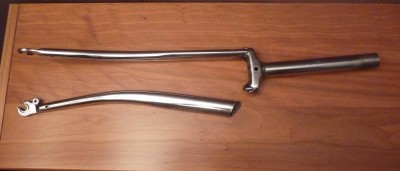
This cyclist had no reason to suspect that the bike’s behavior had anything to do with the fork. The same thing could have happened to anyone. There are as many misconceptions about steel and aluminum as there are about carbon.
VeloNews technical writer Lennard Zinn, a frame builder, former U.S. national team rider, and author of several books including two successful maintenance guides wrote an article entitled: Technical FAQ with Lennard Zinn: Carbon Forks.
Here, Zinn and manufacturers answer questions about rider weight limits, the lifespan of carbon forks and their durability.
“Question: What is the state of thinking on the life-span of carbon forks? Will they last forever, show signs of wear or should they be replaced after some span of years/use? I’ve had a Time fork in my old Merlin since 1998. It’s lived through a few race crashes and seems as good as ever, but I still have trouble regarding it as something as long-lasting as a metal component. Thoughts?–Jon”
Manufacturers’ replies:
From True Temper:
“We are confident on the long-term durability of our forks because we test far beyond the ASTM test standards for fatigue life on forks.
We have two types of fatigue tests:
1) ASTM
2) Ramped load testingASTM standards call for a load of 170 lbs. applied perpendicular to the steering axis, both pushing and pulling for 50,000 cycles without failure.
At True Temper, every Alpha Q model is tested to 250,000 without failure before a design is considered acceptable. Also production models are tested periodically for quality control.
True Temper’s own test is also used on every new model and in routine quality checks. Our test is a ramped load, meaning the load is increased periodically until failure occurs. Starting at 180lbs, the load is increased 45 lbs. every 5000 cycles. Every fork will eventually break. Strong forks will last more than 10,000 cycles with a load of 270 lb. But our minimum standard begins at over 15,000 at 315 lbs. for road forks and 18,000 for cross forks and tandem. But our production forks are stronger than that, often going into the 20-25K range and beyond at loads 0f 360-405 lbs.
Obviously, crashes are uncontrolled events and it is not easy to guess what loading was applied to a component by the speed or violence of the crash. After any crash it is important to thoroughly inspect the frame and components for visible cracks, dents, and bends. An Alpha Q fork that has been damaged (usually evident as a crack) should be replaced.
–Bert Hull
True Temper Sports”
From Kestrel:
“On the lifespan issue, of course the person should contact the manufacturer regarding specifics on the product in question. For carbon forks in general, there should not be any limited life span, as carbon composites themselves are not subject to fatigue failures as metals are. So the fatigue life of a properly made carbon composite is “infinite”. Example, in Kestrel’s case, our forks (as with all our carbon products) have a lifetime warranty and are designed and tested to last a “lifetime” of use for the given product…
–Preston Sandusky
Sand Point Design (Kestrel Bicycles)”
From Easton:
“There are two failure modes that could cause a fork to fail, fatigue or impact. Questions about life span are really questions about fatigue life. How many cycles can a fork survive before it is tired and worn-out? The good news is the fatigue life of carbon fiber is immensely more than that of metals. While the writer expresses concern about his carbon fork lasting as long as a metal component, there is nothing to worry about in terms of fatigue life on a composite fork.
The most likely cause of failure for a composite fork would be impact damage sustained from crashing. Most of the time any damage to a fork from a crash will be visible. Cracks can be seen. We would recommend that the fork be periodically inspected visually at the drop out area and along the fork legs to look for cracks or depressions in the material. Any fork that shows signs of cracking should not be ridden and replaced immediately.
In general terms, a component made from carbon fiber will far out-last a component made from metal.
–John Harrington
Easton Sports”
A Technical White Paper on frame materials written by Calfee Design (founded by the owner of Carbonframes – which made 18 frames, ordered by Greg LeMond, for Team Z) explains more about carbon use in bicycles.
“Carbon fiber frames first appeared in the mid 1970′s. The number increased in the 1980′s as more carbon fiber frames and a few components began to trickle into high-end bike dealers and parts catalogs. But these efforts were mostly limited attempts to save weight and often lacked careful engineering and commitment by the manufacturers. The lasting impression of most carbon fiber products was that they were quirky, flexible, fragile, and very expensive.
Over the past fifteen years, several more innovative carbon fiber framesets have entered the market. These have successfully challenged metal frames in two areas of performance – weight and ride comfort. But even some early versions of a few brands also had a poor record of reliability. Multiple warranty returns to fix cracks, loose dropouts and other unbonded metal parts were common…
Composites have made many advances since the mid ’80′s. Resins, fibers, and epoxies are a lot stronger today. What is more important, understanding how to use these materials has increased tremendously, due in part, to development of sophisticated analysis programs. Composites are more than high-tech weight savers; they are superior structural materials that are revolutionizing the way we build bicycles. A well-designed composite frameset performs better than a metal one. After taking some tentative steps, it has become a viable material in the bicycling industry. A few manufacturers have taken the necessary steps, and have a relatively firm grasp on the capabilities, potentials, and limitations of composites….
Carbon fiber exhibits the most desirable performance characteristics of any of the frame-building materials explored to date. It can be designed to be laterally stiff under heavy pedaling forces and still be light. It can absorb road shocks well, and still handle crisply while delivering undiminished applied pedal power to the drive train. It can be durable and not subject to fatigue failures while remaining strong enough to stand up to unexpected impacts and torsion forces. It can lend itself to attractive finishing and resist corrosion or attack by the elements. And it can be formed in an attractive, functional way allowing it to move through air resistance easily.”
If carbon forks are so prone to catastrophic failure, why are there no high profile carbon bike or fork class action lawsuits circulating on the Internet? In a litigious society like the U.S. (i.e one where people frequently sue one another), at least one carbon fork manufacturer would have been sued out of existence by now. Instead, many carbon fork manufacturers offer a lifetime warranty on their forks. Just from a business standpoint, if the failure rate was high, they would go out of business.
Even if you hate or fear carbon, this video of stunt riding on a carbon road bike is fun to watch. It demonstrates the amount of abuse carbon can take.
Bottom line: regardless of frame and fork material, always maintain your bike. Periodically, have an authorized dealer inspect it. Exercise caution if you ride hard or crash. Never overlook the inherent danger in activities involving equipment. Take proper precautions to avoid unnecessary risk and don’t be immobilized by fear of equipment failure.



Isolate, thanks for this well-researched post. I never understood the hysteria over one frame material or the other in terms of catastrophic failures – except, maybe bamboo. I still have to be convinced about the durability of bamboo.
i really love your page and it is very intersteing and when are you going to write about more fork in the road
I don’t think the issues is quality of material so much as durability of a material after a wreck. My Kona chromoly fork is pretty banged up from years of commuting, I can’t imagine that a carbon fiber fork would still be holding up after a few wrecks and close calls with the same number of impacts that my steel fork has taken. That being the case, of course there are lifetime warranties and a noticeable lack of class-action lawsuits, since a fork failure due to a wreck puts the rider on the line, not the manufacturer. Not to mention, a metal fork will give you some warning before failure where as a cf fork will probably be catastrophic like some of the pictures of fork+squirrel floating around the net.
None the less, great blog and great defense of carbon fiber!
In my own view, no one has proven that carbon fails catastrophically, while steel and other materials do not. What you see online is scary looking pictures due to the fact that carbon looks different from steel when it breaks apart.
If you look at the broken steel fork photo above, you will see that it has snapped apart, rather than bending, as many people claim is typical of steel. The rider had no warning before this steel fork failed – and the bike was never involved in a crash, so he had no reason to suspect a problem with the fork. The same thing could happen to an aluminum fork.
Carbon forks have been ridden, without incident, after crashes – although manufacturers recommend replacing them after a crash. The main difference between carbon and steel, in terms of sudden failure, is that the rider can’t inspect a carbon fork properly due to the lack of visual cues for certain types of damage. After a crash, a carbon fork should be taken to an authorized dealer for a thorough inspection – which involves testing – not just a visual inspection of the fork.
Well, you say in your story that the rider *did* have plenty of warning that the fork was failing and simply misinterpreted it as brake contamination.
I don’t dispute any of your conclusions, but you’re inconsistent on that point.
I don’t see any inconsistency in what I wrote. The rider’s problem was related to braking. He thought that the rims were “sticky.” Here is what he said:
He had no reason to believe that the mechanical issue he was dealing with was related to the fork. Can you explain to me why you think that an unidentified braking problem is warning that a fork is failing?
When the front brakes suddenly act “grabby” and a shimmy develops, potential problems include fork/frame alignment, rim and hub issues, and headset problems. A shimmy is usually not associated with a braking issue. Any time either of these problems appears, the whole front end should be looked at, but when both of them occur at the same time, most people would not dismiss the issue as solely brakes. I am not saying that I would have immediately realized the risk of such a serious problem, but I think you can say that he had warning for the previous week. One cannot conclude that it was catastrophic just because the owner incorrectly associated the symptoms with a brake issue. It sounds like good design and manufacturing trumps materials.
I don’t disagree with your points, in general. However, I think that your conclusion about the “shimmy” warning of a potential fork failure is a stretch. As you said yourself, potential problems could include “fork/frame alignment.” Even if your fork/frame are out of alignment, this is not a warning that your fork will snap in half in a time period as short as a week. It only looks that way to you because you are viewing the problem in hindsight.
Where we agree is on the point that there were symptoms of a potentially serious problem and he should have had them checked out right away, instead of continuing to ride the bike. He obviously didn’t have enough experience to evaluate the bike’s condition properly. But, millions of cyclists do the same thing as he did – all the time – and their forks don’t snap in half as a consequence.
This is very true. All materials will fail under the right conditions, and sometimes without warning – or any symptom obvious enough to point to the precise location of the problem. Good design and manufacturing can reduce the odds of unexpected material failure.
Ironically, after reading your post on carbon forks and deciding on a 2011 Specialized Sirrus Elite, (a very nicely finished aluminum hybrid bike with a carbon fork), I attempted to place an order for the bike yesterday. The first bike shop informed me that they were completely sold out and that I should instead order either a 2011 Sirrus Elite Disk or a 2012 Sirrus Elite. Sadly, the 2012 model was $110 more, even with downgraded components, while the 2011 Elite Disk had an aluminum fork, offering a much inferior ride. When I visited a second shop selling Specialized bikes on the hope that they still might have a 2011 Sirrus Elite in inventory, they explained they just that morning had shipped all of them back to Specialized. The manufacturer had recalled the 2011 Sirrus Elites because its carbon forks were failing all too often! Hopefully, it was just a bad production batch, but it is disquieting nevertheless. After reading your review of the 2011 Jamis Coda Sport, though, I altered my hybrid bike purchase decision and ordered one, carbon fork and all.
Well, your LBS is full of shit.
http://www.specialized.com/us/en/bc/SBCGlobalPages.jsp?pageName=safety_recalls
There are no recall from specialized since 2009, and even before that none were due to carbon forks.. such recall is a f’ing LIE.
Besides that, the sirrus fork is also sharred by the secteur and the roubaix… there are also no recall on those.
I bought a Sirrus Elite 2011 second hand 6 months ago. Before I bought the bike I read up on what to look for with carbon forks as I had never owned a road bike, or carbon forks. I am not a qualified bike mechanic but after very close inspection there were no cracks in the lacquer (which I assume is the first place a carbon fork would show signs of fatigue) de-lamination of layers or cracks in the carbon underneath when the fork was loaded from the front and rear. I was happy that the forks were flexing enough to show any issues with the fork.
I was cycling 6km per day in London to the station, the roads are not the smoothest but no worse than any other town or city. In London you often have to brake hard because other road users, drivers & pedestrains tend not to look as much as they should. I rode the bike for 4 months with no problems but I started to notice a brake shudder only when applying the brakes very softly, which I also thought was an issue with the brake components. I cleaned and checked the forks, did another load test and saw no new cracks or anything abnormal. A month later I had to brake heavily when a pedestrian stepped out in front of me, it was damp, I came off and was uninjured luckily but as I was falling I heard a crack. One side of the forks cracked around the top of the left leg completely and the right leg had cracks in the lacquer. The pedestrian just seemed to pause for a second then RAN off when I was on the ground in the middle of the road so thanks for that whoever you were!
I know that some will say I should have taken the bike to a bike mechanic to have the fork checked out but I can’t see how they would have tested it any differently.
I would never buy a replacement carbon fork, I don’t feel that they are worth the small weight saving. I will be replacing it with aluminium or steel, which I feel will not fail after heavy braking and will show signs of fatigue in the paint. Although not a cause for coming off the bike the fork still failed which im very unimpressed with. For commuter use carbon isn’t worth it, especially when the bike will likely be stolen eventually!
Interesting to read the link below about the brake boss becoming loose, maybe this was the shuddering issue I felt but is unrelated to the forks cracking.
Actually the account of the steel fork does not portray unexpected or catastrophic failure. He noticed a “grabby wobblie” feeling for awhile before takig off the wheel, at which point the fork came apart. The wheel was probably holding the fork tang in place to some extent.
That said, I use both types. On my road bike I have a steel fork, and it feels great. I have two cross bikes, one with steel straight bladed fork, one with the Easton EC 90. In terms of ride quality the steel forks win hands down. You can feel the road, but it’s not a numbing sensation or anything. The steel fork of the ‘cross bike is much more rigid, it tracks better than the EC90. Huge downside of steel forks? It weighs about a one and a half pounds more than the EC90.
So, aside from the significant weight savings, which is important in cyclocross, (and racing in general) I don’t see any advantages in carbon forks.
I think ‘Me’ wrote too soon.
You’re right. I looked it up and a recall on certain Specialized bicycle forks was just issued (August 2011). However, the recall is due to a manufacturing defect related to the brake boss, not catastrophic failure of the carbon forks.
For anyone who may be affected by this problem, the recall notice says the following for Carbon Forks On Certain 2011 Model Year Specialized Bicycles:
Check with Specialized to see if your bike is affected.
I had a 2009 carbon Trek Madone 6.5 with Bontrager Race X Lite carbon fork and it catastrophically failed on me with very little riding and meticulous care taken with the bike…it had never even fallen over much less crashed. I was riding on good surface with no obstructions and the carbon imploded. I have 2 broken and 1 compressed vertebrate from that crash 1 year ago. Absolutely no warning with it. Can send photo if you would like to send an address to send one to for posting to this article. Class Action could very likely happen in the near future as in my visits with attorneys and carbon fibre experts around the country, it is scarey how common place this carbon failure is. It appears bike manufacturers are excellent at fighting each case in court as hard as possible and settling just before a full trial….getting confidentiality agreements signed and it disappears from the public.
Dave,
I would be interested in seeing a photo of your bike and any supporting documentation you have related to your claim that catastrophic failures of carbon are very common. I will e-mail you with an address where you can send it.
I sent an e-mail, a few hours after you posted your comment, to the address you submitted with your comment. If you didn’t receive it, check your spam folder. You can also contact me via my blog’s contact form (click on the contact link at the top of this page). I’m interested in learning about what happened to your bike and how prevalent this problem is.
please resend your email, I must have accidentally deleted from my spam folder. Dave
Hi.
Well, on October 23, 2011, I was riding my 5 months old 2010 Fuji Cyclecros with a Carbon Fiber Fork on a smooth road and they cracked on both side (one side much more than the other though), the front wheel shift, locked, and i went to the road in 15~16 mph! All I could hear before was an unusual noise for a second or so and even though I lower my cadence to see where the noise is coming from, it didn’t last more than a second or two. I broke my nose, several teeth, sprang my both wrist, torn my upper lip and bruise most of my face and my hand.
I’m sorry, but this is a catastrophic failure!
I know that Carbon Fiber is the thing to have etc. but we cannot ignore the fact that on occasion, THOSE FORK BRAKE FOR NO REASON AND WITHOUT ANY WARNING!!!
email me and I’ll email you the pictures.
I had a crash into a curb at night while seated at approximately 10 mph on my Litespeed Vortex ti bike with a Reynolds Ouzo Pro full carbon fork. I went over the bars but was most just dusty but no other harm done. I got back on the bike and started riding again to notice that my head tube had a major crack in it. This was two years ago. I finally had the frame welded and have carefully inspected the fork for damage. I cannot find any with the naked eye. What can a LBS do that I cannot do myself as far as inspection? I am in the process of buying another fork only because everyone says to replace the fork after a crash. I personally know of two people that have had carbon fork failure related crashes, however I do not have all the info about the crashes as I was not there. I am very tempted to ride the original fork but everytime I do a 45mph decent it will always be in the back of mind that I am riding a previously crashed fork.
Alex,
It is generally recommended to replace a carbon fork after a crash because of the difficulty of ensuring the integrity of carbon fiber after it has sustained an impact. You can test the fork yourself, if you are willing to take the risk of missing a problem and having the fork fail. As for your LBS, the mechanics should be trained to inspect carbon for damage — and they have more experience at finding damage than you do since they see more forks.
If you want to test the fork yourself, there are some resources which can help you to test it properly. According to a carbon inspection document written by Trek, you should do the following:
- Check for scratches, gouges, or other surface problems.
- Check the part for loss of rigidity.
- Check the part for delamination.
- Listen for unusual noises.
The document describes how to perform these tests. There is also a video which shows you how to inspect a carbon fiber part for damage.
If I were you, I would take the fork to your LBS and let them inspect it. You can make a decision based on their advice. But, the safest thing to do is to replace the fork so you will have peace of mind when you ride.
Pingback: How Strong is Your Fork? Reynolds Composites Drop Test | SOPWAMTOS – Society of People Who Actually Make Their Own Shit
I’ve ridden countless centuries and have interacted with hundreds of Cyclists and have never met anyone who has encountered a Catastrophic failure of a Carbon fiber component, including Frame and Forks.
In fact, I’m the only one (unlucky huh)? I was riding my $7K roadbike on a fast group century, we were on a smoothly paved main road when I heard a “Poink” sound and felt it through the Handlebars. The next thing I knew, a Paramedic was kneeling over me, I had been unconscious for about 20 minutes. I found out sometime later that my Forks had sheared off a few inches below the crown. At 21.4 mph, according to my Friends Garmin 705. I dove head-first into the Tarmac.
I suffered severe head trauma, broken neck, 5 crushed vertebrae and a few other broken Bones.
7 Days in ICU, 7 weeks in Hospital, 5 months in a Body Cast, 6 months off work, $450K in medical Bills plus 8 months PT later I’m back on the Bike.
Check your Frames and Forks regularly, irrespective of material, don’t take chances, you can’t wind back the clock. Catastrophic failure can change your life for ever.
Oh yeah, my Helmet deffinately saved my life, it was totally wrecked.
Be safe out there Guys!!
unfortunately, i believe those failure fall under “product liability”, which is very difficult to prove, or very difficult to find a lawyer to take the case…
I’m still very surprise as how the fork fail all of a sudden.
my next bike will be all carbon fiber BUT with a custom made steel fork. yes, this fork can fail as well, but much, much slower with lots of warning.
Switched out a full carbon fork for a straight bladed steel fork. (salsa). The steel fork allows a little more minor road feel to come through, though bigger hits are deflected much better than the carbon fork. Overall, the steel feels better. It weighs 800 grams, the carbon is 450 grams. By the way, my frame is steel, columbus foco . Also, I don’t race, and could stand to lose 40 lbs, so, bike weight is moot. I think racers should all ride carbon, but most folks riding for fitness/pleasure, could enjoy riding just as much, if not more, on steel.
Hi,
this article is a light in the dark…
i loved it!
will be interesting for me to know your opinion about the carbon FACT recalls of 2011 and 2012 by Specialized company…
Front brakes seems to leaves the fork like a fatigue fail, so if for composite material talk to fatigue fail is uncorrect what it cuold be…?
http://www.bikerumor.com/wp-content/uploads/2012/02/2012-specialized-tricross-sport-bicycle-recall2.jpg
bye,
Giuseppe
Where can I go to get a steel fork installed? Every time I bring this up at the bike shop, they tell me I’m crazy and that carbon is 100% safe. I love biking but not enough to risk my face and spine.